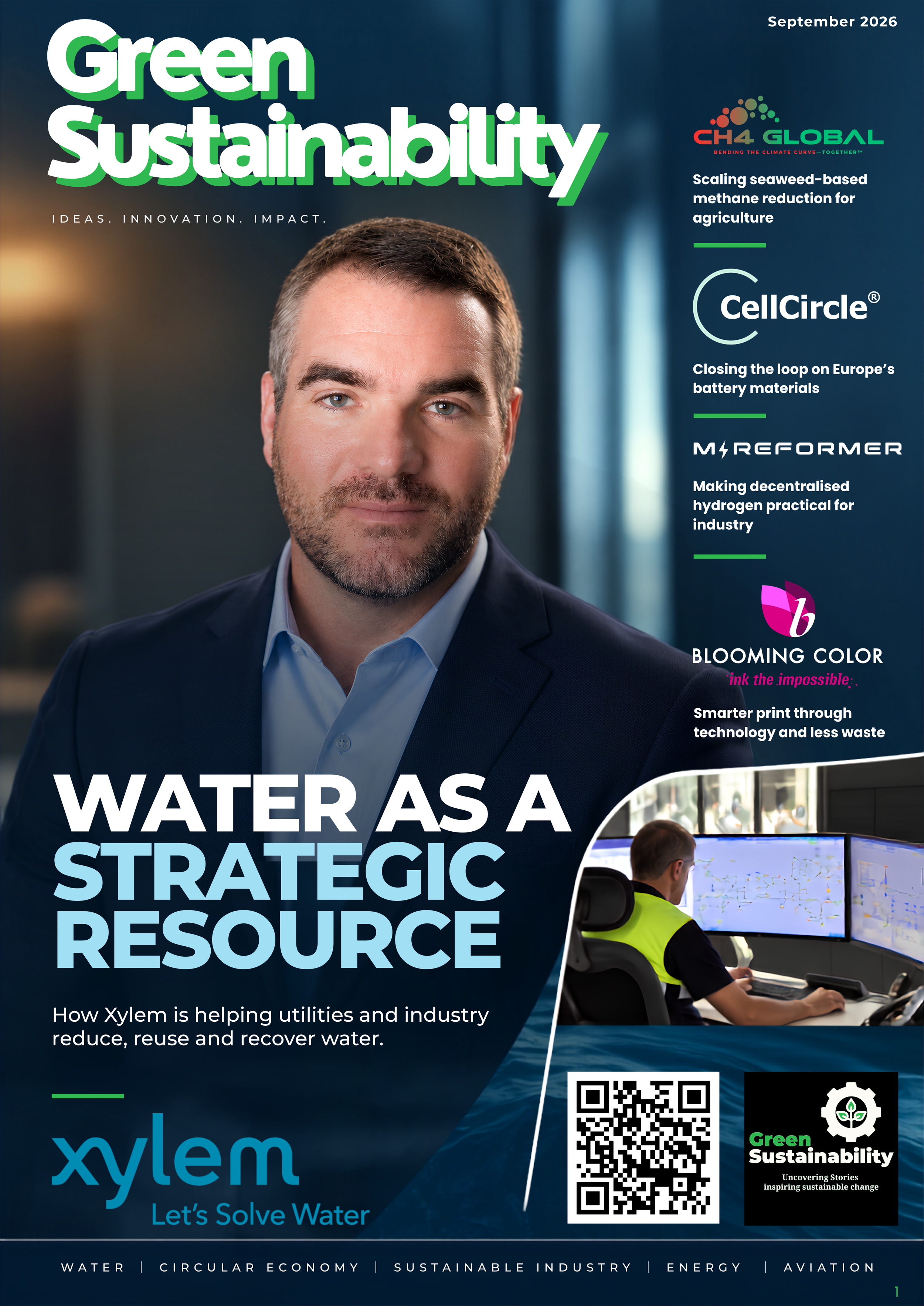

Green Sustainability September 2026: Water, Methane, Battery Recycling and Industrial Innovation
The September 2026 edition of Green Sustainability brings together six companies addressing some of the most important challenges facing industry today, from water efficiency and methane reduction to battery circularity, hydrogen production, aviation maintenance and more sustainable manufacturing.
This edition features Xylem, CH4 Global, CellCircle, Methanol Reformer, Atitech and Blooming Color, examining how each organisation is combining technology, operational change and commercial strategy to improve environmental performance without losing sight of cost, resilience and long-term competitiveness.
Xylem: Rethinking water as a strategic resource
Water is often treated as a utility that enters an industrial site, passes through a process and leaves as wastewater. Xylem is challenging that approach by helping customers understand the complete journey water takes through their operations.
Its Water Walk approach is designed to identify inefficiencies, reuse opportunities and areas where water, energy and operational performance are closely connected. These can range from leaks and unnecessary discharges to more complex opportunities involving cooling systems, wastewater treatment and reuse.
The feature also explores produced water from oil and gas operations, where treatment technologies are creating opportunities to turn difficult wastewater streams into potential resources.
The wider message is straightforward: better water management does not always begin with major infrastructure. It can start with understanding where water is being used, where it is being lost and where it could remain in productive use for longer.
CH4 Global: Taking methane reduction to commercial scale
Agricultural methane remains one of the major challenges in reducing greenhouse gas emissions from food production.
CH4 Global is developing a commercial response based on Asparagopsis, a red seaweed capable of significantly reducing enteric methane emissions from cattle.
Its Methane Tamer™ feed supplement has demonstrated reductions of up to 90 per cent in controlled trials, while the company is now focused on scaling cultivation, production and commercial deployment.
Chief Executive Officer Steve Meller explains why the challenge extends beyond the science itself. For climate technologies to succeed at scale, they must also work for farmers, food producers, retailers and consumers.
CH4 Global's story therefore sits at the intersection of climate science, agriculture and commercialisation, showing what is required to move a promising technology from research into real-world use.
CellCircle: Creating a shorter route back into Europe's battery factories
Battery recycling is becoming increasingly important as Europe expands electric vehicle production and seeks greater control over critical material supply chains.
German start-up CellCircle is taking a different approach to conventional battery recycling.
Instead of reducing battery materials to metals, salts or mixed black mass before rebuilding them into active materials, CellCircle is developing a direct recycling process designed to preserve functional battery materials for reuse.
The company sees production scrap from battery factories as its first major commercial opportunity. These materials can be relatively homogeneous, traceable and unaged, making them particularly suitable for a direct recycling process.
CellCircle is now working towards an industrial pilot process with a capacity of at least 500 tonnes per year as it attempts to demonstrate that direct recycling can operate economically at a comparatively small scale.
The potential significance reaches beyond recycling itself. Preserving active materials could also support a more resilient European battery supply chain.
Methanol Reformer: Closing hydrogen's logistics gap
Hydrogen has significant potential across industrial, transport and energy applications, but transporting and storing compressed hydrogen remains difficult and expensive.
Barcelona-based Methanol Reformer is addressing that challenge by using methanol as a transportable hydrogen carrier.
Its modular systems convert methanol into hydrogen at the point where it is required, allowing customers to use established liquid-fuel logistics rather than transporting compressed hydrogen over long distances.
The company's systems are already being applied across industrial, off-grid and maritime projects, including applications where hydrogen is combined with fuel cells to produce electricity.
The feature explores the commercial argument behind the technology, as well as the role bio-methanol, e-methanol and carbon capture could play in reducing its environmental impact further.
Atitech: The future of sustainable aviation maintenance
Aviation sustainability is often discussed in terms of aircraft technology and alternative fuels, but maintenance, repair and overhaul also has an important role to play.
Italian MRO provider Atitech has expanded significantly in recent years, building a network of facilities supporting both established and next-generation aircraft.
Its strategy combines operational growth with digitalisation, renewable energy and greater efficiency.
The company is exploring predictive maintenance and artificial intelligence while working towards a more paperless maintenance environment. At the same time, it continues to invest in renewable energy, electric ground equipment and wider ESG initiatives.
The result is a view of sustainable aviation that extends beyond the aircraft itself to the infrastructure and operations required to keep fleets flying safely and efficiently.
Blooming Color: Reimagining sustainable print
Commercial printing is also being reshaped by technology.
US-based Blooming Color has moved increasingly towards personalised, on-demand production supported by API integration, digital printing, automated workflows and fulfilment.
The approach allows customers to align production more closely with actual demand, reducing the risk of excess inventory becoming obsolete or being discarded.
Its sustainability work also extends into materials, recycling, renewable energy and supplier collaboration.
Blooming Color is working with technology and material partners including HP, GPA, Midland, Enfocus, Horizon and Moll, while its participation in a Canva and Watershed-supported community solar initiative demonstrates how customers and suppliers can work together on supply-chain emissions.
For Blooming Color, the objective is not to present print as impact-free. It is to make production more precise, measurable and responsible.
Read the September 2026 edition
Together, these six companies show how sustainability is becoming increasingly embedded within industrial strategy.
Water efficiency, methane reduction, battery recycling, decentralised hydrogen, aviation maintenance and digital manufacturing may appear to be very different challenges, but the underlying questions are often the same.
How can companies reduce waste? How can existing resources be used more effectively? How can new technologies scale commercially? And how can environmental improvements strengthen rather than compromise business performance?
The September 2026 edition of Green Sustainability explores those questions through the companies, technologies and people working on them today.
Read the full September 2026 edition of Green Sustainability.